



What an evening actually feels like
By Cyril François
Somebody has booked an evening. You have been invited by email. Here is the whole of it.
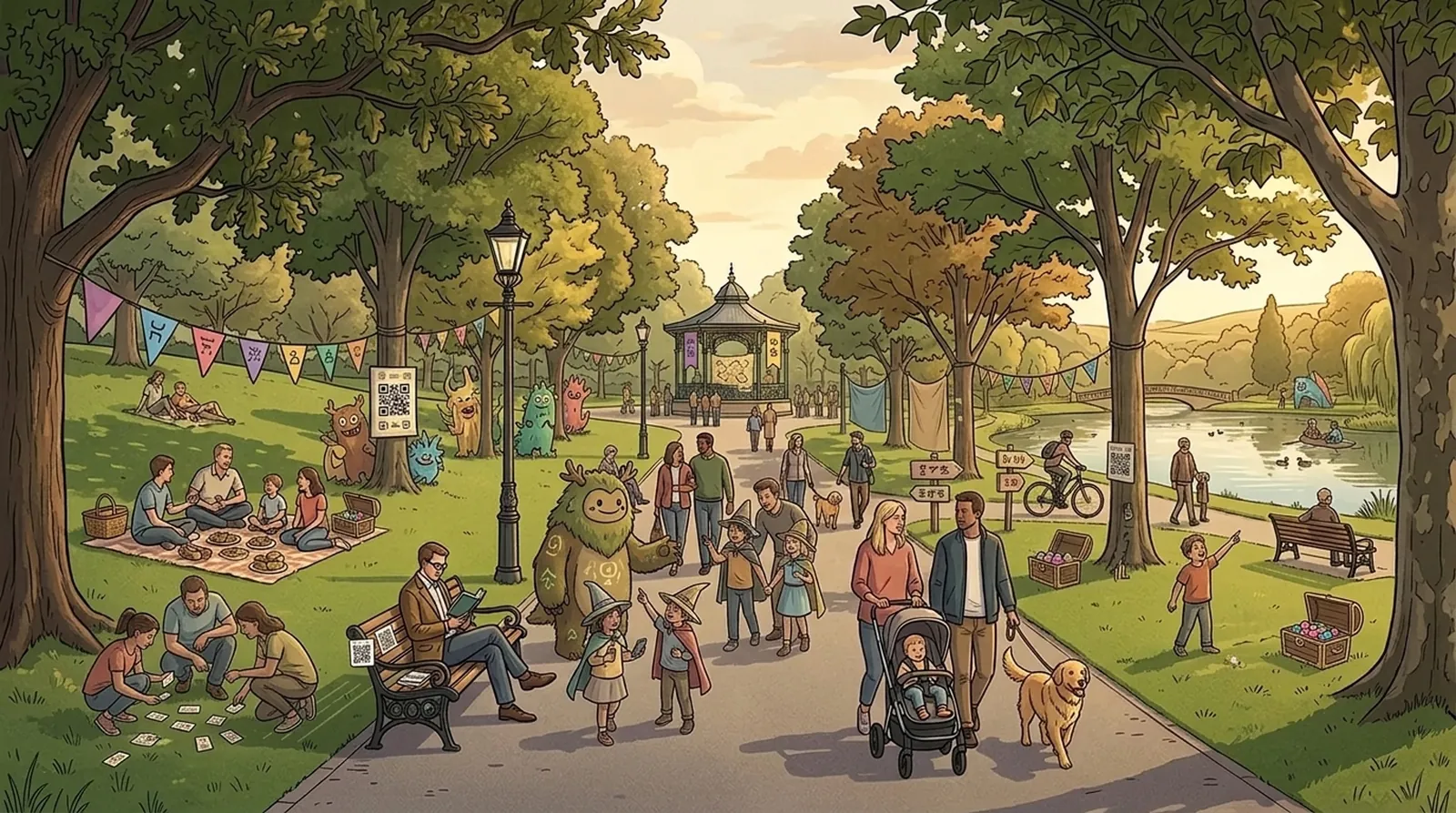
You arrive somewhere ordinary. A square, a bar, a museum after closing, a garden. There is no set. That is deliberate: the place is already the place, and the first small pleasure of the night is realising that the bakery on the corner is in the story.
You get a phone and a team. No app to install. You scan a code on a poster and you are in, with three or four other people, sharing one pool of Action Points and one set of clues. Everything anyone finds, everyone sees. That is what stops the evening becoming four people playing alone next to each other.
The first twenty minutes are quiet. You walk. You find the places on your map, scan what is there, and read. Points accumulate because you moved, not because you were clever. Nobody is stuck yet, and everybody is reading the same three paragraphs and forming a different theory about them.
Then somebody talks to a character and it goes wrong. They ask the direct question. They get the shrug. Somebody else says "let him warm up first" and spends four questions on nothing in particular, and the fifth answer arrives twice as long as the ones before it. That is the moment the team works out what game they are playing.
The middle hour is the good part. People split up because there is more ground than time. They come back with fragments. Somebody reads out a line a character told them and somebody else says "that is not what he told me". Nobody planned that; it happened because two people asked the same character the same thing an hour apart.
Then the accusation. You put a clue in front of a character and their story changes on the spot. It is more satisfying than it has any right to be, and it is the point where a team that was doing a treasure hunt starts doing an investigation.
The last twenty minutes are a huddle. The game asks the team a handful of questions about what actually happened, and they have to agree on the answers. There is always one person who has been right for an hour and could not get anybody to listen, and one theory that everybody loved that turns out to be a coincidence.
And then it ends and people stand around talking about it, which is the only review that matters.
Two hours. A real place. No costumes, no actors to book, no set to build. That is the entire proposition.